Your parents' super visa, one step at a time.
Their documents never leave your laptop.
A super visa lets your parents stay in Canada for up to five years at a time. Getting one is 14 steps across two countries, two people and one government portal, and nothing tells you which step is next. I'm about to apply for my own parents in India, so this week I built the thing I'd want before I start.

Get the Super Visa Tracker
- Web app, one family, one password
- Records only, never your documents
Observation log
IRCC's site tells you the rules. It never tells you what to do next, or whose turn it is. I read the pages for myself and watched friends go through the rest.
- 1.I read the eligibility, forms and documents pages three times and still couldn't say what the first step was.
- 2.A friend's IRCC sign-in codes went to his inbox in Canada while his father sat at the portal in India. Every step needed both of them awake.
- 3.Another ran it from WhatsApp: passport scans in one chat, bank statements by email, photos in a Drive folder. He couldn't say which copy was final.
- 4.A step the parents owned sat untouched for a week before anyone noticed. Nothing nudged either side.
Do you have this problem?
Who else has it?
I asked three people who had brought their parents over, or tried to, before building anything. One line from each.
Did it themselves
Ran the whole thing from a WhatsApp thread and a folder of PDFs. Found out a document was missing when IRCC sent the application back.
Paid a consultant
Paid about $2,000 for someone to tell them what to collect, then still did the collecting. The parents got instructions second-hand.
Gave up on the super visa
Started the super visa, stalled for months with no idea which step was next, and settled for a plain visitor visa instead.
Averages over 2011 to 2023 from IRCC's report to Parliament on the super visa, data extracted 22 March 2024.
Scorecard
Running a parent's super visa application without missing a step or a deadline. Six criteria, 1 to 5 each. A 1 on Acute or Reach kills a candidate, whatever else it scores.
- 4/5
Acute
Today's alternative is canada.ca, a WhatsApp thread, and a consultant if you can afford one. Miss a document and IRCC returns the whole application; IRCC refused 61,930 super visa applications between 2011 and 2023, and of the 18,186 who reapplied, only 22.5% got it on the second try. Not a 5: nobody is in danger, they are just stuck.
- 2/5
Frequency
A family does this once, maybe twice in a lifetime. While it runs, 'what do I do next' comes up every week for four to five months, but that is not the same as a daily problem. This is the weak score and I am not dressing it up.
- 5/5
Reach
IRCC approves about 20,600 super visas a year, and India accounts for 56% of all positive decisions since 2011, 149,483 of 267,740. Among people who became permanent residents between 2016 and 2021, 246,995 were born in India, the largest group from any country, and their parents are the next wave.
- 4/5
Current spend
Licensed consultants charge $750 to $2,750 per super visa application on top of IRCC's $100 fee and $85 for biometrics, so money already changes hands. Most families I know did it themselves on evenings and weekends, and nobody pays for the tracking part, so a 4 rather than a 5.
Source: Mirzoyan Immigration fees, Sawubona Canada fees, IRCC super visa
- 4/5
Why now
On 15 July 2026 IRCC paused new intake for the parents and grandparents sponsorship program, so the super visa is the only open route. Since 28 January 2025 the insurance can come from an OSFI-approved foreign insurer, which changes what the checklist says. And India's processing time fell from 208 days in March to 50 days in July 2026, so the family's own delays are now the long pole. Not a 5: the steps themselves haven't changed, and a careful spreadsheet would have worked five years ago.
Source: Fragomen, 16 July 2026, IRCC notice, 28 January 2025, CIC News, 2 July 2026
- 5/5
Buildable in a week
Spec written on 7 October, built and tested on 8 October. Shipped inside the week.
Total 24 of 30
- Five candidates this week. Scored but not built: getting better at building with AI, the way LeetCode did for coding. 25 of 30, the highest in the pool. No objective grader exists, the skill shifts every quarter, and nobody screens for it yet. Parked as the long bet, probably a VibeIQ extension.
- Not scored: a visitor visa tracker for siblings and friends. Same engine, but the IRCC step list still has to be pulled, so it is week 2 of this build rather than a candidate of its own.
Kills
What to watch tonight
Fails AcuteCanadians spend about 80 hours a year deciding, in a Roku survey of 2,043 adults from June 2026. 21 of 30, but Acute is a 2: the cost is annoyance, not harm. Set aside.
Screenshots cluttering the desktop
Fails ReachMore screenshots since working with AI, all on the desktop, hard to find. 20 of 30. Reach is a 2: no number on who has it, and macOS already offers save locations and Spotlight. Set aside.
Banking tasks with an AI watching over your shoulder
Fails Buildable in a weekClosing an account, say. 20 of 30. Buildable is a 2: you can't ship inside a bank in a week, and a screen watcher over a bank site raises credential and liability questions. Parked, the problem is real.
The pick
Super visa, 24 of 30. The only candidate in the pool that passed Acute, Reach and Buildable together. Frequency is a 2 and I built it anyway. Part of that is personal: I have been putting this application off for far too long, and building the tool was how I stopped delaying. The rest is that the fix needed no new credentials, no file uploads and no cost. I wrote the constraints down before building, so they were a test I could fail rather than an argument for what I'd already made.
No personal files on a server
Passports, bank statements and birth certificates stay on my laptop. The app can know a document exists, never hold it.
Always one next step
On open, it says what to do, who acts, and links to the IRCC page for it. Nothing else competes with that.
Works for both sides
My parents don't get an app or a login. They get a one-page note in plain English for each thing they own.
Read canada.ca and keep notes
Fails Always one next stepIRCC's pages are complete and generic. They never say which of the 14 steps is yours today, or whose turn it is.
A spreadsheet or Notion board
Fails Works for both sidesI'd be the only one looking at it, and nothing nudges anyone when a row sits still for a week.
A consultant
Fails No personal files on a serverYou hand over every document and $750 to $2,750, and you still do the collecting. My parents would get instructions second-hand.
A cloud document vault for visa applications
Fails No personal files on a serverThe whole point is uploading passports and statements to someone else's servers. That is the one thing I wasn't willing to do.
What's left: a private web app that tracks records, not files
- No personal files on a server
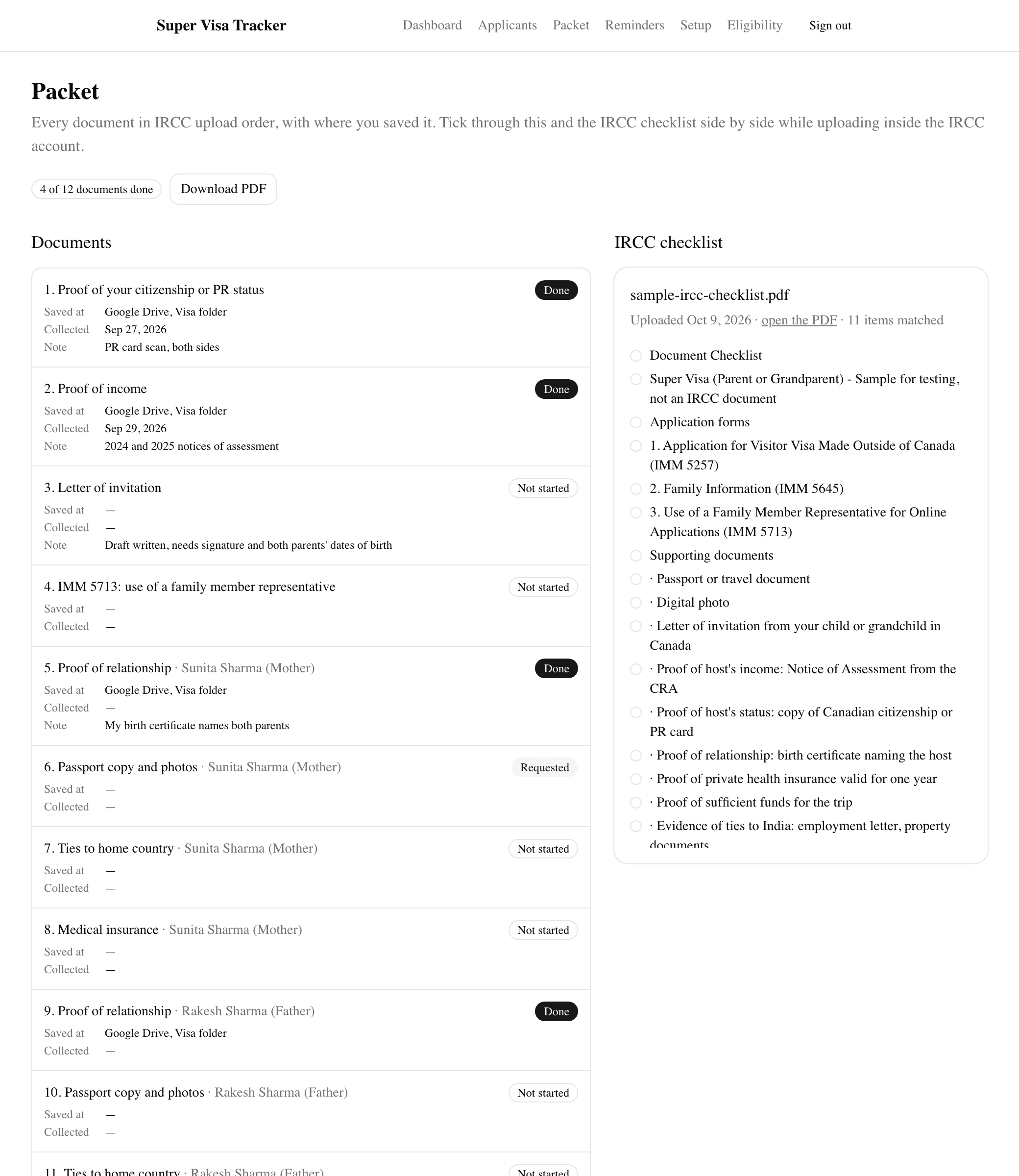
- Each document is a record: status, date collected, where you saved it, a note. The one file it keeps is IRCC's own checklist, so it can compare the two lists.
- Always one next step
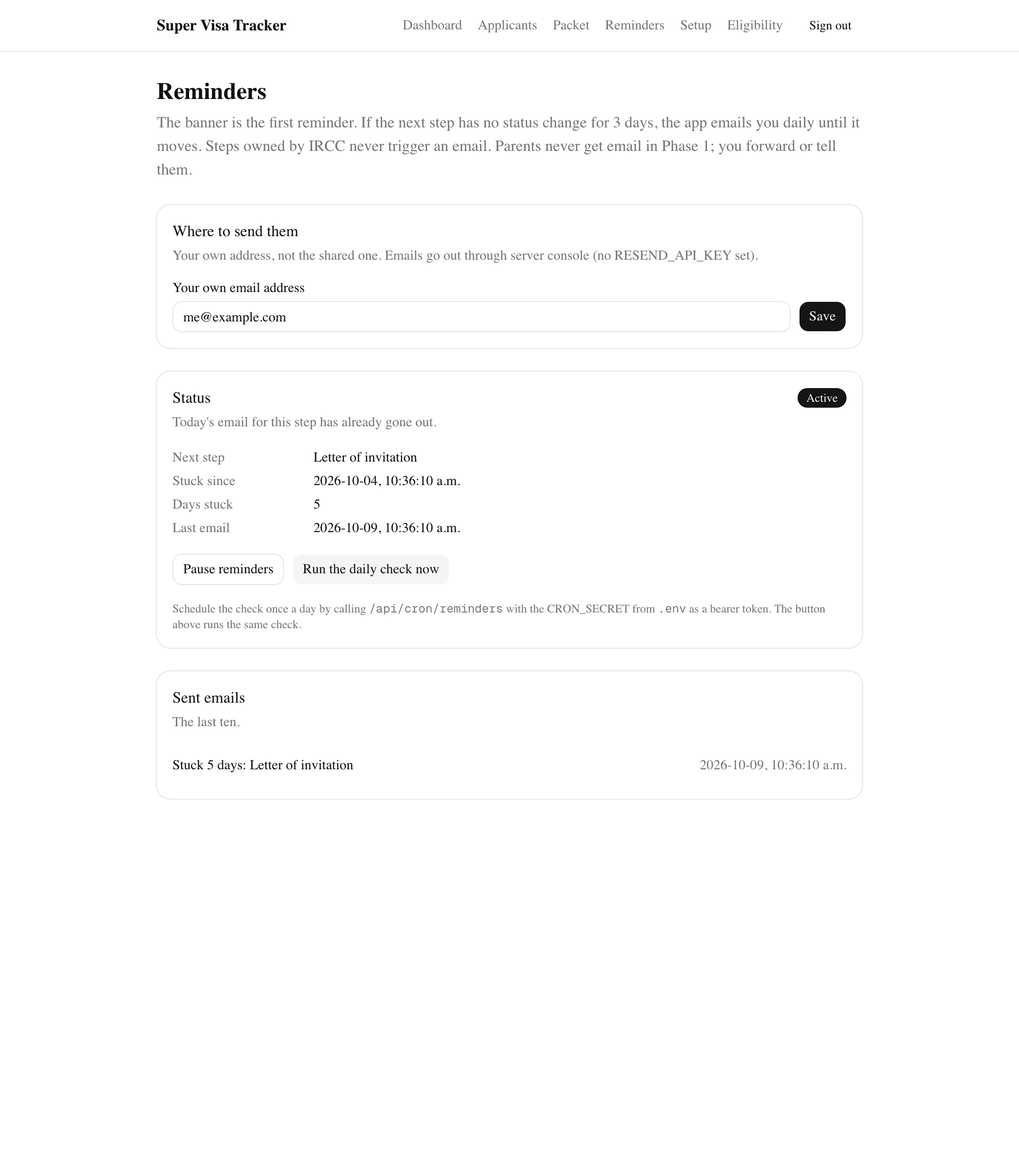
- The banner is the biggest thing on screen. If the next step sits still for three days, it emails you once a day until it moves. IRCC's own waiting never triggers one.
- Works for both sides
- Every step your parents own has a Send to parents button: a one-page PDF with what to do, where to go, what to bring and what to send back. You attach it to WhatsApp yourself.
What did I build?
Super Visa Tracker is a web app for one family. It starts with the five eligibility questions and the minimum income for your family size, copied from IRCC with the date it was checked. Then a shared email and IRCC account, because every sign-in code lands in one inbox and both sides need it. From there it tracks all 14 steps, the shared ones once and the rest for each parent, with one next-step banner, a progress bar and a status on every document. Upload the checklist from your IRCC account and it compares it with its built-in list. When everything before Submit and pay is done, it lays the packet out in IRCC's upload order with the checklist alongside, and you download it as a PDF.


Signals
- Votes
- The two votes on this page: whether you have the problem, and whether it was worth building.
Was it worth it?
Yes, for my family. The problem is real: about 11,500 Indian families a year run these 14 steps alone, consultants charge up to $2,750 to run them for you, and with the sponsorship lottery paused this is the only route left. What I am not sure about is whether it is a product. Frequency is a 2. A family needs this once, and once they are through it they never come back, so there is no habit to build and no reason to pay monthly. It might be a free tool that earns trust, or the first module of something consultants would pay for. The vote below and the list are the only signals I'm watching on this one.
Is It Worth Solving?
Every week I log problems, score them against the same six criteria, kill the weak ones and build the winner. Then I report whether it was worth it, at 30 and 90 days. Sometimes the answer is no.
Want this run on your business?
Every week I log problems, score them against the same six criteria, kill the weak ones and build the winner. I do the same for companies. You bring the observation log from your customers, your support queue and your team. I score it, kill what fails, and build the strongest one with you.
hello@idxstudioz.com, subject “Run the method.”